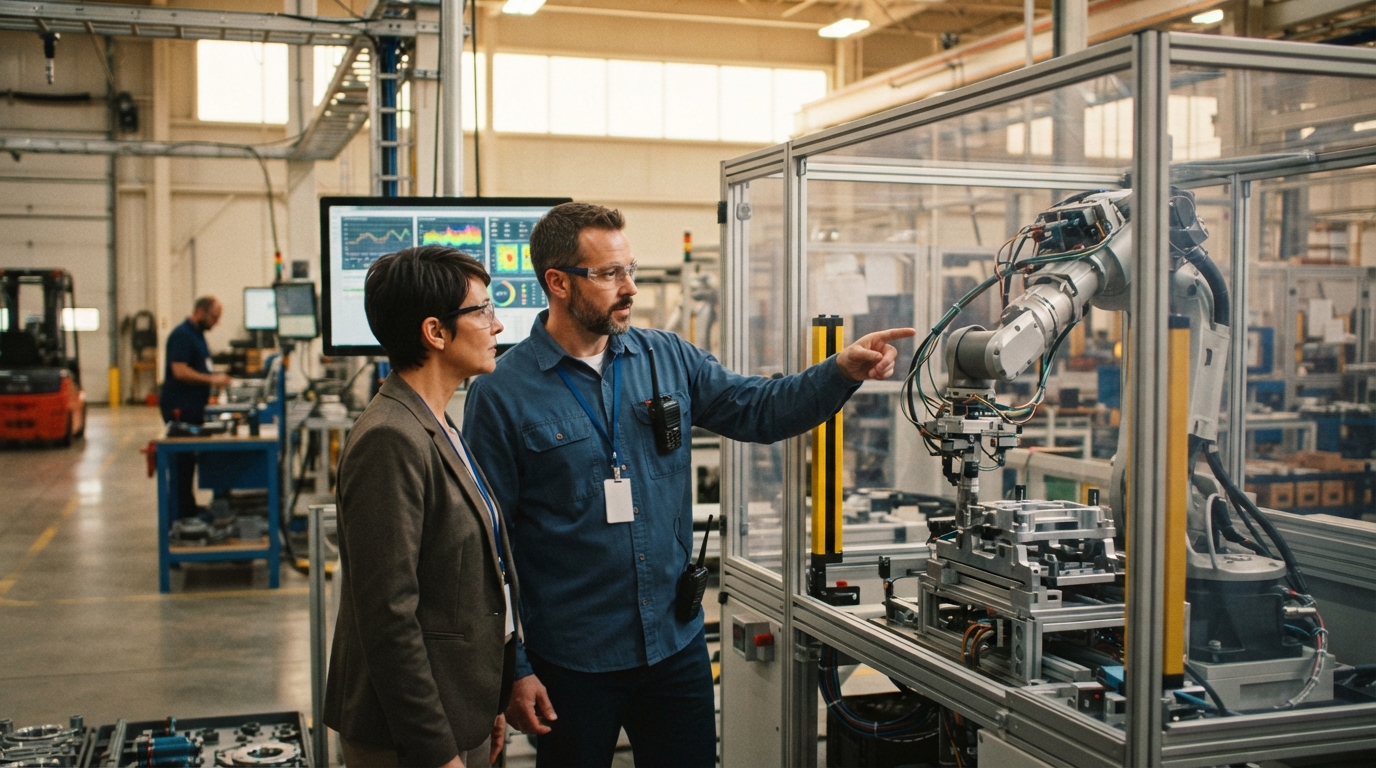
Manufacturing is shedding its old skin. For generations, industrial production ran on rigid lines, isolated programmable logic controllers, and batch-driven schedules that treated change as an enemy. That paradigm has collapsed under the weight of volatile supply chains, bespoke customer demand, and acute skilled-labor scarcity.
Today, modern plants behave less like static mechanical vaults and more like responsive cyber-physical organisms. Telemetry streams from every spindle, conveyor, and thermal sensor. Algorithms interpret those signals in real time, adjusting tolerances and routing materials before bottlenecks harden into downtime. Understanding the smart factory automation trends defining industrial competitiveness is no longer a technical curiosity for plant engineers; it is an existential imperative for executives steering capital across global operations.
From Mechanization to Cognitive Autonomy
Early factory automation excelled at repetition. Hard-wired relays and fixed transfer lines moved heavy parts at predictable speeds, provided product mix stayed narrow and demand remained steady. Yet high changeover friction penalized agility. Retooling a line for a new geometry or SKU meant hours or days of recalibration and scrap.
Modern industrial transformation moves far beyond mechanical speed. It unites ubiquitous industrial Internet of Things (IIoT) instrumentation, deterministic networking, edge intelligence, and simulation models into a closed-loop operational fabric. Machines do not merely execute pre-programmed routines; they perceive variance, infer root causes, and coordinate across subsystems.
Demographics reinforce this urgency. Across industrial economies, manufacturers face persistent vacancies for automation engineers, machinists, and technicians. Automation increasingly serves not to displace workers wholesale, but to preserve throughput and keep lines running when qualified talent is scarce.
Core Smart Factory Automation Trends Defining the Production Floor
While hype cycles around industrial technology often exaggerate overnight reinvention, practical smart factory automation trends cluster around capabilities that deliver measurable gains in uptime, yield, energy efficiency, and adaptability.
1. Edge AI and Low-Latency Closed-Loop Control
Cloud analytics have their place in historical warehousing and cross-plant benchmarking, yet high-speed shop-floor control cannot wait for round-trip network latency. When a high-cadence press stamps sheet metal or a vision camera inspects thousands of components per minute, milliseconds govern whether a defect is caught immediately or multiplied across a batch.
Edge AI embeds inference directly onto local gateways, industrial PCs, and smart sensors. By processing high-frequency vibration, acoustic, thermal, and optical streams at the point of operation, systems trigger micro-adjustments or reject anomalies autonomously—even if wide-area connectivity falters.
2. Digital Twins and Virtual Commissioning
A digital twin is far more than a static three-dimensional CAD rendering. Synchronized with live shop-floor telemetry and physics-based simulation, a dynamic twin mirrors equipment states, thermal loads, queuing behavior, and material flow in real time.
Manufacturers use virtual commissioning to test PLC logic, robotic trajectories, and cell layouts in a risk-free sandbox before bolting a single bracket to the concrete. During live operations, engineers run what-if simulations to stress-test schedule shifts, evaluate maintenance windows, and diagnose stochastic bottlenecks without halting physical output. High-performing plants deploy bounded twins around critical bottleneck cells first rather than attempting a monolithic, multi-year replica of an entire campus.
3. Vision-Guided Automation and Sensor Fusion
Quality assurance has historically suffered from sampling bias and human inspection fatigue. Manual checks catch a fraction of surface micro-cracks, misalignments, or assembly omissions, allowing subtle flaws to travel downstream where rework costs escalate exponentially.
Modern machine vision pairs high-resolution optics, multispectral or infrared imaging, and neural inspection models with multi-sensor fusion. Cameras do more than grade finished goods; they guide robotic pick-and-place arms on unindexed parts, verify fastener torque and orientation, and flag subtle tooling wear. Crucially, contemporary training workflows require far fewer labeled images than legacy vision suites, putting automated inspection within reach of mid-sized fabricators and assemblers.
4. Collaborative Robotics, AMRs, and Servitized Hardware
Rigid robotic cells caged behind safety fencing remain indispensable for heavy payloads and relentless high-volume cycles. Yet modern manufacturing increasingly demands nimble reconfigurability across shorter production runs.
Collaborative robots (cobots) equipped with force-torque sensing and speed/separation monitoring work safely alongside human operators on tasks like kitting, machine tending, dispensing, and delicate assembly. Autonomous mobile robots (AMRs) dynamically navigate aisles using LiDAR and vision mapping to ferry raw materials and work-in-process totes without fixed floor tracks.
Financially, Robotics-as-a-Service (RaaS) and modular hardware subscriptions are lowering capital barriers. Rather than absorbing massive upfront capital expenditure before proving workflow fit, operators can scale robotic capacity incrementally while bundling maintenance and software updates into predictable operating expense.
5. Agentic Orchestration Across IT and OT
For years, information technology (IT) and operational technology (OT) inhabited separate universes. Enterprise resource planning (ERP) systems spoke in orders and invoices, while manufacturing execution systems (MES), SCADA, and programmable controllers spoke in tags, cycles, and alarms.
Bridging this divide through unified data fabrics and event-driven integration unlocks genuine responsiveness. Agentic AI workflows take coordination a step further: when a machine signals impending bearing degradation or an upstream supplier reports a delay, software agents can cross-check inventory buffers, propose revised production sequences, generate maintenance work orders in the CMMS, and surface clear trade-offs to plant supervisors.
6. Energy Telemetry and Decarbonization as Cost Control
Utility bills have ceased to be background noise on the income statement. Volatile power markets, grid surcharges, and peak-demand tariffs make kilowatt-hours a direct determinant of gross margin.
Smart metering at the circuit, machine, and process level exposes parasitic idle loads, compressed-air leaks, and thermal waste that aggregate utility bills conceal. By correlating energy draw with output states and scheduling power-intensive cycles off-peak, manufacturers cut operating costs while generating verifiable emissions and resource data required by customers and regulators.
7. Industrial Cybersecurity and Algorithmic Governance
Every connected sensor, wireless gateway, and remote diagnostic link expands the attack surface of the plant floor. A cyber intrusion into OT networks does not merely expose data; it can halt physical production, corrupt calibration parameters, or create safety hazards.
Resilient architectures enforce strict network segmentation between IT and OT, zero-trust identity controls, encrypted telemetry, and immutable audit logs. Simultaneously, as autonomous decision-making spreads across quality gates, scheduling, and safety interlocks, boards and plant leaders are formalizing governance frameworks to ensure traceability, human override authority, and regulatory compliance.
Comparing Legacy Automation and Smart Factory Architectures
The contrast between traditional automated lines and modern connected plants is stark across architecture, adaptability, and decision cadence.
| Dimension |
Traditional Automated Line |
Smart Factory Architecture |
| Control & Data Flow |
Siloed PLCs/SCADA; manual data exports |
Interconnected IIoT, edge compute, unified data fabric |
| Changeover Agility |
Hardware retooling; lengthy downtime |
Software-reconfigurable cells, modular tooling, cobots/AMRs |
| Maintenance Posture |
Scheduled intervals or reactive breakdown |
Condition monitoring, anomaly detection, predictive alerts |
| Quality Assurance |
Periodic sampling and manual inspection |
Inline computer vision, sensor fusion, automated rejection |
| Planning & Simulation |
Static spreadsheets; physical trial runs |
Digital twins, virtual commissioning, live constraint modeling |
| Cyber & Governance |
Air-gapped assumptions; informal oversight |
OT/IT segmentation, telemetry security, explicit AI/automation governance |
Why Pilots Stall—and How Leaders Scale Successfully
Industry postmortems reveal a sobering pattern: many smart factory pilots succeed on a single test bench yet stall before enterprise rollout. The culprit is rarely a lack of clever algorithms. It is organizational fragmentation, fragmented master data, or automation layered atop broken processes.
Automating a chaotic workflow simply accelerates chaos. If part numbers are inconsistently named, cycle times lack standardized definitions, or shift handoffs rely on tribal memory, even sophisticated analytics will produce brittle recommendations.
Leaders who scale smart factory automation trends reliably follow disciplined operational habits:
-
Anchor Every Initiative to a Measurable Bottleneck: Target high-cost pain points—chronic micro-stops, scrap spikes, changeover drag, or energy peaks—with clear baseline metrics like Overall Equipment Effectiveness (OEE) and Mean Time Between Failures (MTBF).
-
Fix Data Hygiene and Context First: Standardize timestamps, asset hierarchies, and fault codes so sensor readings carry unambiguous operational meaning.
-
Design Modular, Interoperable Interfaces: Favor open industrial protocols, clean APIs, and decoupled edge/cloud layers to avoid vendor lock-in and simplify future upgrades.
-
Embed OT/IT Security and Governance Early: Treat segmentation, access control, and human-in-the-loop escalation rules as foundational architecture rather than afterthoughts.
-
Invest in Operator Empowerment: Involve frontline machinists, line leads, and maintenance techs during pilot design, turning them into co-architects who trust and refine the tools rather than viewing them as surveillance.
Strategic Implications for Industrial Leaders
The competitive moat in manufacturing is shifting. Proprietary machinery alone rarely sustains advantage when competitors can source comparable equipment globally. Advantage increasingly resides in operational learning speed: how quickly a plant detects process drift, diagnoses root causes, rebalances capacity, and propagates improvements across sites.
Executives who treat digitization as a series of disconnected gadget purchases will accumulate technical debt and pilot fatigue. Those who treat smart factory automation trends as an integrated operating system—combining edge responsiveness, simulation foresight, flexible robotics, and disciplined governance—build factories capable of absorbing shocks, protecting margins, and turning complexity into a strategic asset.
For a closer look at how manufacturers are applying AI, robotics, and smart production practices on the shop floor, watch
Smart Factory Trends 2026: AI, Automation & EV Production. The video examines real-world automotive and industrial examples to illustrate how connected production systems and automation are evolving in practice.