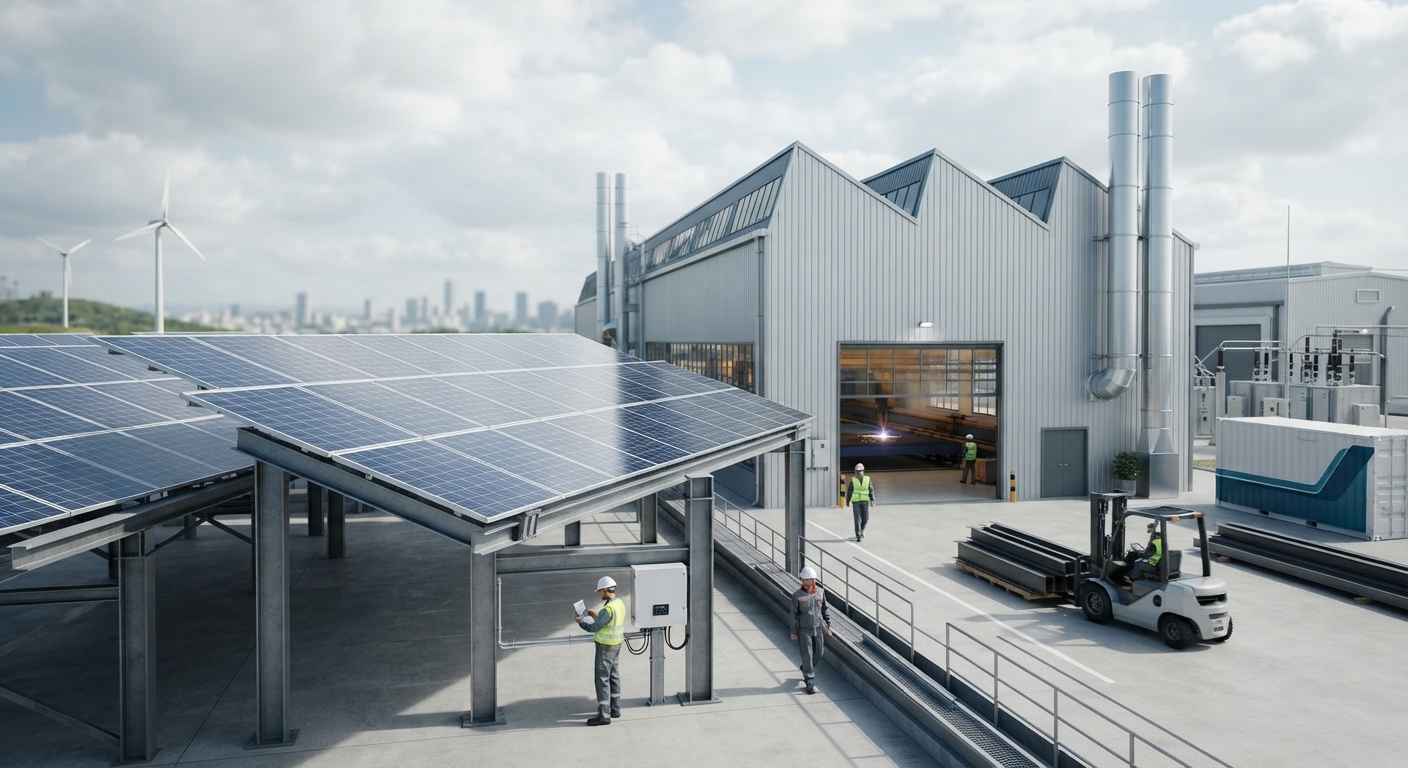
The industrial sector stands at a critical juncture. For over two centuries, the engine of heavy manufacturing has been fueled by the combustion of fossil fuels, a paradigm that built modern civilization but has also precipitated a global climate crisis. The sector, encompassing the production of steel, cement, chemicals, and other energy-intensive materials, is responsible for approximately one-fifth of global carbon dioxide emissions. The challenge is monumental: how to decarbonize these industries without compromising output, economic stability, or global development. This profound shift, the Green energy transition in manufacturing, is no longer a theoretical aspiration; it is an operational imperative.
The urgency is dictated by both environmental necessity and economic reality. Regulatory pressure is mounting worldwide, with carbon border adjustments and stringent emissions caps becoming standard. Simultaneously, consumer demand for sustainable products is increasing, and investors are actively divesting from high-carbon assets. The manufacturing sector, therefore, must undergo a radical metamorphosis. This involves more than a simple switch from coal to solar or wind power; it requires a fundamental reconfiguration of industrial processes, material flows, and energy systems. It is a transition from a linear, extractive model to a circular, regenerative one.
This article delineates the multifaceted drivers, technological pathways, and strategic imperatives of the Green energy transition in manufacturing. By understanding the complexities involved, industrial leaders can navigate this transformation, turning decarbonization from a regulatory burden into a significant competitive advantage.
The Decarbonization Imperative: Why Industry Must Act
The pressure on heavy manufacturing to decarbonize is not singular; it is a convergence of several powerful forces. Understanding these drivers is essential for grasping the scope and pace of the required changes.
1. Regulatory Landscape and Carbon Pricing
Governments globally are implementing increasingly stringent climate policies. The landmark Paris Agreement, ratified by nearly all nations, commits signatories to limiting global temperature rise. To achieve these targets, countries are enacting domestic legislation. Examples include the European Union’s Emissions Trading System (ETS) and the proposed Carbon Border Adjustment Mechanism (CBAM), which places a tariff on carbon-intensive imports, effectively leveling the playing field for domestic industries that bear carbon costs.
Carbon pricing mechanisms, whether through emissions trading or direct carbon taxes, are becoming ubiquitous. This internalizes the cost of pollution, making low-carbon production methods economically viable. Manufacturing firms that fail to anticipate these costs risk sudden and severe financial penalties.
2. Investor Pressure and ESG Criteria
The financial world is undergoing a rapid realignment towards Environmental, Social, and Governance (ESG) criteria. Large institutional investors, pension funds, and asset managers are increasingly factoring a company’s carbon footprint into their investment decisions. The Task Force on Climate-related Financial Disclosures (TCFD) provides a framework for companies to disclose their climate-related risks, further increasing transparency.
Access to capital is becoming contingent on a clear and credible decarbonization strategy. Companies with high emissions profiles face increasing difficulty in securing financing, or they incur a higher cost of capital. Conversely, businesses leading the Green energy transition in manufacturing are attracting significant investment, viewed as lower-risk and better-positioned for long-term value creation.
3. Market Demand and Supply Chain Decarbonization
Downstream industries, from automotive to consumer electronics, are under pressure from consumers and regulators to report on their Scope 3 emissions—those generated across their entire value chain. Consequently, major corporations are demanding decarbonized materials from their suppliers. A steel producer that cannot supply “green steel” risks losing contracts with major automotive manufacturers.
This creates a “cascade effect,” where the decarbonization of final products forces the decarbonization of intermediate and raw material industries. The ability to offer low-carbon materials is becoming a prerequisite for market access, transforming sustainability from a niche marketing tool into a fundamental competitive differentiator.
4. Energy Security and Price Volatility
Heavy manufacturing is highly vulnerable to energy price shocks and supply disruptions, particularly concerning natural gas and oil. The geopolitical instability of fossil fuel markets underscores the strategic risk of dependency.
The Green energy transition in manufacturing offers a pathway to greater energy security. Localized renewable energy generation, such as on-site solar or wind, combined with energy storage and grid flexibility, can provide a stable and predictable energy cost base. This shields manufacturers from the volatility of global commodity markets, enhancing long-term operational resilience.
Technological Pathways to Industrial Decarbonization
The decarbonization of heavy manufacturing requires a suite of technologies. There is no “silver bullet.” Instead, a combination of energy efficiency, electrification, hydrogen adoption, and Carbon Capture, Utilization, and Storage (CDUS) is necessary.
1. Energy Efficiency and Electrification
The most immediate and cost-effective step is to minimize energy consumption. Industrial processes are replete with inefficiencies. Waste heat recovery systems, advanced process controls, and the adoption of more efficient motors and pumps can yield significant reductions. The International Energy Agency (IEA) estimates that efficiency improvements could deliver over 40% of the required emissions reductions in the industrial sector.
The second step is electrification. Many industrial heating processes currently rely on fossil fuels. Technologies such as industrial heat pumps, electric arc furnaces (EAFs) for steel production, and electric boilers offer a direct pathway to decarbonization. This is only truly “green,” however, if the electricity is sourced from renewable generation. The synergy between energy efficiency, electrification, and the power sector transition is paramount.
2. The Hydrogen Economy: A Fuel for High-Temperature Processes
A major challenge in heavy manufacturing is the need for very high temperatures—often exceeding 1000°C—for processes like cement calcination and steel reduction. These temperatures are difficult to achieve cost-effectively with electricity alone. Hydrogen, specifically “green hydrogen” produced via electrolysis using renewable energy, emerges as a critical solution.
Green hydrogen can replace fossil fuels as a feedstock and a reductant in processes where direct electrification is not feasible. For instance, in the “Direct Reduced Iron” (DRI) method for steelmaking, green hydrogen can act as the reducing agent, replacing coking coal and eliminating the associated CO2 emissions. While the cost of green hydrogen is currently high, economies of scale in electrolyzer manufacturing and falling renewable energy costs are projected to make it competitive within the next decade.
3. Material Efficiency and the Circular Economy
The Green energy transition in manufacturing extends beyond energy to the materials themselves. The circular economy paradigm offers a powerful framework for reducing emissions. This involves designing products for durability, reuse, remanufacturing, and recycling, thereby reducing the need for primary material production, which is the most energy-intensive stage.
In the steel industry, increasing the use of scrap steel in EAFs significantly lowers emissions compared to the traditional blast furnace-basic oxygen furnace (BF-BOF) route. Similarly, in the cement industry, using supplementary cementitious materials (SCMs)—such as fly ash or slag—as clinker substitutes reduces the calcination emissions. The transition to a circular model requires systemic changes in product design, collection systems, and secondary material markets.
4. Carbon Capture, Utilization, and Storage (CCUS)
For some heavy industries, complete decarbonization through efficiency, electrification, and hydrogen is extremely difficult or economically prohibitive in the short-to-medium term. This includes processes where CO2 is an inherent chemical byproduct, such as limestone calcination in cement production. For these “hard-to-abate” sectors, CCUS is a crucial bridging and complementary technology.
CCUS involves capturing CO2 emissions from industrial point sources, transporting them, and either storing them geologically (Carbon Capture and Storage – CCS) or utilizing them to produce synthetic fuels, chemicals, or building materials (Carbon Capture and Utilization – CCU). While CCUS technology is proven, its deployment at scale faces challenges related to infrastructure, cost, and public acceptance. Nevertheless, its role in the Green energy transition in manufacturing for specific sectors is widely acknowledged by climate models.
Sector-Specific Challenges and Solutions
The strategies for decarbonization vary significantly across different heavy manufacturing industries. A tailored approach is required for each.
1. Steel Production
The steel industry accounts for approximately 7% of global emissions. The conventional BF-BOF route is highly carbon-intensive. The primary pathway for decarbonization involves a transition to EAFs utilizing scrap steel, combined with the adoption of DRI processes that use green hydrogen. Another promising, albeit nascent, technology is direct electrolysis of iron ore.
The challenge lies in the capital intensity of existing blast furnaces, which have long lifecycles. Early retirement or significant retrofitting of these assets requires substantial investment and supportive policy frameworks.
2. Cement and Concrete
Cement production is responsible for about 7% of global CO2 emissions. Approximately 60% of these emissions arise from the calcination process itself—the chemical decomposition of limestone (CaCO3) into lime (CaO) and CO2, which is unavoidable with current technology. The remaining 40% comes from fossil fuel combustion.
Decarbonization strategies for cement include improving kiln energy efficiency, substituting fossil fuels with alternative fuels (e.g., biomass, waste-derived fuels), reducing the clinker-to-cement ratio through the use of SCMs, and, critically, implementing CCUS at cement plants to capture the process emissions.
3. Chemical and Petrochemical Industry
The chemical industry is diverse, producing a vast array of products, and is the largest industrial consumer of energy. Emissions result from fuel combustion for heat and steam, as well as from the use of hydrocarbons as feedstocks for products like plastics, fertilizers, and solvents.
Solutions involve improving energy efficiency, electrifying steam generation, and utilizing green hydrogen and captured CO2 as feedstocks to produce chemicals in a process known as “Power-to-Chemicals.” The transition to bio-based feedstocks is also a viable pathway for certain products.
The Business Case for Sustainable Manufacturing
The Green energy transition in manufacturing is not merely an environmental necessity; it presents a significant economic opportunity. Forward-thinking manufacturers are recognizing that proactive decarbonization creates value in multiple ways.
1. Cost Reduction and Operational Efficiency
While the initial capital expenditure for green technologies can be high, the long-term operational savings are substantial. Energy efficiency improvements directly reduce OPEX. Investments in on-site renewable generation, coupled with energy storage and smart energy management systems, can provide a hedge against rising and volatile energy prices. The circular economy model, by reducing material inputs and waste disposal costs, further enhances profitability.
2. Enhanced Brand Reputation and Market Access
Sustainability is increasingly central to corporate brand value. Manufacturers that demonstrate genuine leadership in the Green energy transition in manufacturing build strong brand equity, enhance customer loyalty, and attract top talent. As discussed, the ability to supply low-carbon products is becoming a critical factor in securing high-value contracts with downstream customers who are themselves committed to decarbonizing their supply chains.
3. Future-Proofing and Risk Mitigation
Proactive decarbonization mitigates significant financial, regulatory, and reputational risks. Companies that act early avoid the costs of stranded assets and are better prepared for the implementation of carbon taxes and stricter regulations. They also build resilience against supply chain disruptions associated with both climate impacts and geopolitical instability in fossil fuel markets. This future-proofing strategy ensures long-term viability and competitiveness.
4. Innovation and New Revenue Streams
The transition necessitates innovation, which in turn creates new business opportunities. Manufacturers that develop and commercialize low-carbon technologies, processes, and materials can license their intellectual property or create entirely new product lines. The demand for green materials—such as green steel, green cement, and green chemicals—is projected to grow exponentially, creating lucrative markets for early movers.
The Role of Policy and International Cooperation
Achieving the Green energy transition in manufacturing requires more than individual corporate action. It demands a supportive policy environment and robust international cooperation to overcome market failures and ensure a just transition.
1. Supportive Policy Frameworks
Governments have a critical role to play through a combination of “carrots” and “sticks.” Effective policy measures include:
-
Carbon Pricing: Implementing clear and predictable carbon pricing signals, such as robust carbon taxes or cap-and-trade systems, to internalize the cost of emissions.
-
Investment Support: Providing public funding, grants, loans, and tax incentives to de-risk investments in innovative but capital-intensive low-carbon technologies, such as green hydrogen plants and CCUS infrastructure.
-
Green Public Procurement: Leveraging the significant purchasing power of governments to create early markets for low-carbon materials by mandating their use in public infrastructure projects.
-
Standards and Regulations: Establishing clear performance standards for industrial products (e.g., defining “green steel”) and implementing regulations that phase out inefficient processes and mandate emissions reductions.
2. International Cooperation and Carbon Border Adjustments
Given the global nature of heavy manufacturing and the risk of “carbon leakage”—where production relocates to jurisdictions with less stringent climate policies—international cooperation is essential. Carbon Border Adjustment Mechanisms (CBAMs), while potentially controversial, are designed to prevent carbon leakage and encourage other nations to adopt climate policies by ensuring that importers face equivalent carbon costs.
Furthermore, international collaboration on research, development, and demonstration (RD&D) of breakthrough technologies can accelerate their deployment and reduce costs. Knowledge sharing and technology transfer to developing nations are also crucial to ensure a global and equitable transition.
Conclusion: A Transformative Era for Industry
The Green energy transition in manufacturing is not a choice between economic growth and environmental protection; it is the foundation for future industrial prosperity. The sector that once powered the industrial revolution must now reinvent itself to power a sustainable one. The challenges are undeniable: the capital intensity of heavy industry, the long lifecycles of existing assets, and the need for technological breakthroughs for hard-to-abate processes.
However, the drivers for change are inexorable—regulatory pressure, investor demand, market forces, and energy security concerns. The technological pathways are increasingly clear: energy efficiency, electrification, green hydrogen, and CCUS. The business case is compelling: cost reduction, enhanced brand value, risk mitigation, and innovation-led growth.
Success in this transformative era requires bold leadership, strategic foresight, and a commitment to collaboration across the entire value chain and with policymakers. The companies that embrace the Green energy transition in manufacturing will not only survive; they will thrive, shaping the future of industry and securing a sustainable world for generations to come. The industrial journey towards decarbonization is complex and demanding, but it is the only viable path forward.